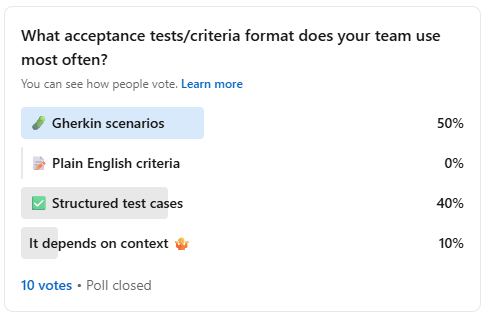
Acceptance tests should create a shared understanding between developers, testers, product owners and business stakeholders.
But what is the best format for expressing them clearly?
🔸 THE POLL OPTIONS
🥒 Gherkin scenarios
The classic Given / When / Then structure.
It provides a shared vocabulary and may become executable documentation with tools such as Cucumber. However, poorly written Gherkin can quickly become verbose and difficult to maintain.
📝 Plain English criteria
Simple sentences or bullet points describing the expected behaviour.
This format is accessible to almost everyone and requires little training. The downside is that natural language may introduce ambiguity or leave edge cases unspecified.
✅ Structured test cases
Preconditions, test steps, input data and expected results.
This format offers precision and traceability, especially for complex or regulated systems. However, maintaining detailed test cases can require significant effort.
🤷 It depends on context
The right format may depend on:
▪️ The complexity of the feature
▪️ The people reviewing the tests
▪️ Regulatory and traceability requirements
▪️ The automation tools being used
▪️ The team’s existing conventions
The best acceptance test is not necessarily the most sophisticated one.
It is the one that the whole team can understand, challenge, execute and maintain.
“Any damn fool can write code that a computer can understand. The trick is to write code that humans can understand.”-- Martin Fowler
👇 What format does your team use most often?
🔘 🥒 Gherkin scenarios
🔘 📝 Plain English criteria
🔘 ✅ Structured test cases
🔘 It depends on context 🤷
#SoftwareTesting #AcceptanceTesting #Gherkin #Cucumber #BDD #Agile #QualityAssurance #TestAutomation #SoftwareDevelopment #Java
Go further with Java certification:
Java👇
Spring👇
SpringBook👇
JavaBook👇