☕🗄️ jOOQ: 🔟 INSIGHTS on TYPE-SAFE SQL, DATABASES & AI
☕🗄️ jOOQ: 🔟 INSIGHTS on TYPE-SAFE SQL, DATABASES & AI
What if writing SQL in Java felt like writing SQL itself?
🔸 TL;DR
In A Bootiful Podcast, Josh Long interviews Lukas Eder, the creator of jOOQ (Java Object Oriented Querying).
They explore how jOOQ brings type-safe SQL into Java, supports dynamic query transformations, integrates database features, and even benefits from AI-assisted debugging.
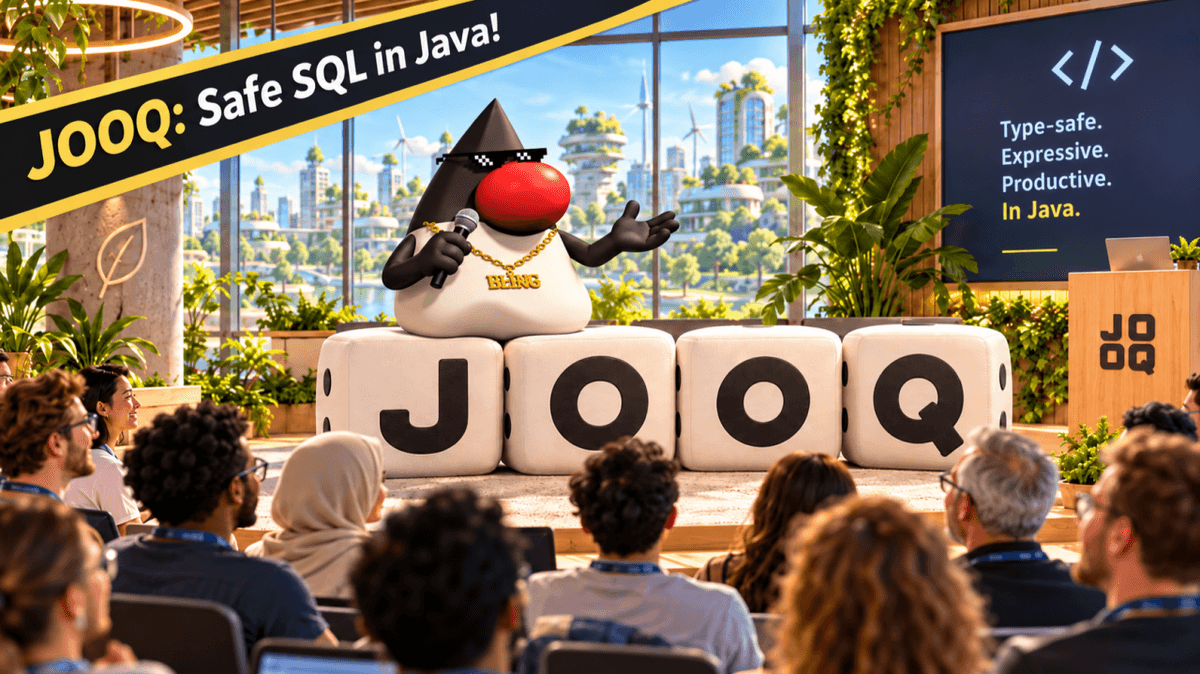
Here are 🔟 insights from their conversation.
🔸 🔟 VERBATIM FROM THE INTERVIEW
1️⃣ [jOOQ started off as a type safe embedded domain specific language that models SQL as a language in Java.]
jOOQ uses a Domain-Specific Language (DSL) to express SQL queries directly in Java, combining SQL's expressiveness with Java's type system.
#DSL
2️⃣ [So you can just type check your SQL queries directly in your Java code and you can use auto completion and everything.]
Java compilation and IDE autocompletion help detect query mistakes earlier, reducing reliance on runtime SQL errors.
import static com.example.jooq.tables.Customer.CUSTOMER;

// CUSTOMER is generated from your database schema
List<String> names = dsl
    .select(CUSTOMER.NAME)       // ✅ IDE autocompletion
    .from(CUSTOMER)
    .where(CUSTOMER.ID.eq(42))   // ✅ Type-safe Integer
    .fetch(CUSTOMER.NAME);       // ✅ List<String>

// CUSTOMER.ID.eq("42");        // ❌ Type mismatch
// CUSTOMER.UNKNOWN_COLUMN;     // ❌ Compilation error
#TypeSafety
3️⃣ [You're actually not really writing the SQL code itself, but you're writing the expression tree that generates SQL.]
jOOQ builds an expression tree representing the query, then renders SQL for the target database dialect.
import static com.example.jooq.tables.Customer.CUSTOMER;

// 1. Build SQL expressions as Java objects
Condition condition = CUSTOMER.ID.eq(42);

// 2. Compose the SQL expression tree
Select<?> query = dsl
    .select(CUSTOMER.NAME)
    .from(CUSTOMER)
    .where(condition);

// 3. Render the tree into SQL
String sql = dsl.renderInlined(query);

// Example generated SQL (dialect-dependent):
// SELECT customer.name
// FROM customer
// WHERE customer.id = 42
#SQL
4️⃣ [You can have transformations that add predicates, that add joins dynamically depending on whatever you have in your session.]
Query transformations allow jOOQ to modify SQL at runtime, enabling reusable rules and context-dependent query behavior.
import static com.example.jooq.tables.Customer.CUSTOMER;
import static com.example.jooq.tables.Orders.ORDERS;

// 1. Session-dependent parameters
int tenantId = 7;
boolean requirePaidOrder = true;

// 2. Build the initial query
Condition filter = CUSTOMER.TENANT_ID.eq(tenantId);

SelectJoinStep<?> query = dsl
    .select(CUSTOMER.ID, CUSTOMER.NAME)
    .from(CUSTOMER);

// 3. Dynamically add JOIN and predicate
if (requirePaidOrder) {
    query = query
        .join(ORDERS)
        .on(ORDERS.CUSTOMER_ID.eq(CUSTOMER.ID));

    filter = filter.and(ORDERS.STATUS.eq("PAID"));
}

// 4. Execute the composed query
var customers = query.where(filter).fetch();
#DynamicSQL
5️⃣ [It's always going to be added automatically to all of your SQL statements, including writing statements.]
jOOQ's policy feature can inject tenant-specific predicates into queries, helping enforce row-level access restrictions.
import org.jooq.*;
import org.jooq.impl.DefaultPolicyProvider;

import static com.example.jooq.tables.Customer.CUSTOMER;

// 1. Define a tenant-specific policy
int tenantId = 42;

configuration.set(new DefaultPolicyProvider()
    .append(CUSTOMER, CUSTOMER.TENANT_ID.eq(tenantId))
);

DSLContext dsl = DSL.using(configuration);

// 2. SELECT: tenant filter added automatically
dsl.selectFrom(CUSTOMER).fetch();

// 3. UPDATE: tenant filter added automatically
dsl.update(CUSTOMER)
   .set(CUSTOMER.NAME, "Alice")
   .where(CUSTOMER.ID.eq(10))
   .execute();

// 4. DELETE: tenant filter added automatically
dsl.deleteFrom(CUSTOMER)
   .where(CUSTOMER.ID.eq(10))
   .execute();

// All statements are restricted to TENANT_ID = 42
#DataSecurity
6️⃣ [SQL has so many constructs that change nullability very implicitly.]
LEFT JOINs and other SQL constructs can introduce nullable results. This makes guaranteeing nullability through Java types particularly challenging.
import static com.example.jooq.tables.Customer.CUSTOMER;
import static com.example.jooq.tables.Orders.ORDERS;

// ORDERS.ID is declared NOT NULL in the database

var results = dsl
    .select(CUSTOMER.NAME, ORDERS.ID)
    .from(CUSTOMER)
    .leftJoin(ORDERS)
    .on(ORDERS.CUSTOMER_ID.eq(CUSTOMER.ID))
    .fetch();

// LEFT JOIN can introduce NULL values
for (var row : results) {
    String name = row.get(CUSTOMER.NAME);
    Integer orderId = row.get(ORDERS.ID);

    if (orderId == null) {
        System.out.println(name + " has no orders");
    } else {
        System.out.println(name + " ordered " + orderId);
    }
}
#NullSafety
7️⃣ [You want to really push your operation inside of the database with whatever technology the database offers.]
Process data close to where it lives. SQL operations and stored procedures can avoid unnecessary transfers and client-side computations.
CREATE PROCEDURE mark_order_paid(IN p_order_id INT)
LANGUAGE SQL
AS $$
    UPDATE orders
    SET status = 'PAID'
    WHERE id = p_order_id;
$$;
import com.example.jooq.routines.MarkOrderPaid; // 1. Instantiate the generated procedure MarkOrderPaid procedure = new MarkOrderPaid(); // 2. Set the input parameter procedure.setPOrderId(101); // 3. Execute the procedure in the database procedure.execute(dsl.configuration()); // Alternative: generated convenience method Routines.markOrderPaid(dsl.configuration(), 101);
#Performance
8️⃣ [jOOQ will pick up the view in the code generator, make it available like all the other tables.]
Database views can encapsulate complex, static SQL while remaining accessible through generated Java types.
CREATE VIEW paid_orders_summary AS
SELECT
    customer_id,
    SUM(total_amount) AS total_revenue
FROM orders
WHERE status = 'PAID'
GROUP BY customer_id;
import static com.example.jooq.tables .PaidOrdersSummary.PAID_ORDERS_SUMMARY; import java.math.BigDecimal; // jOOQ generates PAID_ORDERS_SUMMARY // from the database view var results = dsl .select( PAID_ORDERS_SUMMARY.CUSTOMER_ID, PAID_ORDERS_SUMMARY.TOTAL_REVENUE ) .from(PAID_ORDERS_SUMMARY) .where(PAID_ORDERS_SUMMARY.TOTAL_REVENUE .gt(new BigDecimal("1000"))) .fetch(); results.forEach(System.out::println);
#CodeGeneration
9️⃣ [Then you can call. It's just a Java function, a Java method.]
jOOQ generates Java stubs for stored procedures and functions, allowing developers to invoke database logic through typed Java APIs.
CREATE PROCEDURE activate_customer(IN p_customer_id INT)
LANGUAGE SQL
AS $$
    UPDATE customer
    SET active = TRUE
    WHERE id = p_customer_id;
$$;
import static com.example.jooq.Routines.activateCustomer; // jOOQ generates the Java method from the procedure // 1. Call the stored procedure as a Java method activateCustomer(dsl.configuration(), 10); // 2. Alternative: use the generated Routine class ActivateCustomer procedure = new ActivateCustomer(); procedure.setPCustomerId(10); procedure.execute(dsl.configuration());
#StoredProcedures
🔟 [And you can ask it to write a test, you know.]
Lukas describes how Claude uncovered subtle R2DBC rollback exception-handling bugs and helped generate regression tests using the jOOQ API.
#AIEngineering
🔸 TAKEAWAYS
▪️ SQL is not the enemy: jOOQ embraces SQL instead of hiding its capabilities.
▪️ Type safety matters: Generated Java APIs make database interactions easier to maintain.
▪️ Dynamic SQL is powerful: Runtime transformations enable sophisticated database behavior.
▪️ Database-first performance: Push computation to the database when appropriate.
▪️ AI can assist experts: Even experienced framework authors can benefit from AI-supported debugging and regression testing.
▪️ Abstractions have limits: SQL nullability, dialect differences, and database semantics still require expertise.
💬 Have you used jOOQ in production, or do you prefer JPA/Hibernate or plain JDBC?
#Java #jOOQ #SQL #SpringBoot #Database #TypeSafety #SoftwareEngineering #JavaDevelopment #AI #BackendDevelopment
Go further with Java certification:
Java👇
https://bit.ly/javaOCP
Spring👇
SpringBook👇
JavaFullstackBook👇