🧩🗄️ how do you fetch a multi-level object graph? JOIN/ MULTISET/ SPLIT/ DEPENDS
🧩🗄️ how do you fetch a multi-level object graph? JOIN/ MULTISET/ SPLIT/ DEPENDS
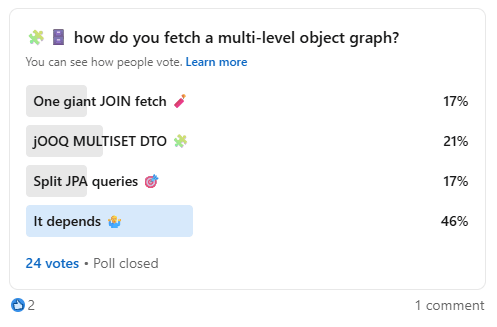
Let’s say you have this kind of model:
Post -> Comments -> Votes -> Tags
And now you need to fetch it efficiently.
What would you choose? 👇
Poll options:
1️⃣ One giant JOIN fetch 🧨
2️⃣ jOOQ MULTISET DTO 🧩
3️⃣ Split JPA queries 🎯
4️⃣ It depends 🤷♂️
🔸 WHAT EACH OPTION MEANS
▪️ One giant JOIN fetch 🧨
Everything in one query: posts, comments, votes, tags.
It looks attractive, but it can create a Cartesian product:
posts × comments × votes × tags.
▪️ jOOQ MULTISET DTO 🧩
Instead of flattening everything into duplicated rows, you shape the result as nested DTOs.
Very interesting for read models and API responses.
▪️ Split JPA queries 🎯
Fetch the root first, then fetch one collection at a time.
Less magical, but often more predictable with Hibernate/JPA.
▪️ It depends 🤷♂️
Because the right answer depends on the use case: detail page, paginated list, read-only API, collection size, caching, and performance constraints.
As Martin Fowler said:
“Any fool can write code that a computer can understand. Good programmers write code that humans can understand.”
Fetching strategy is not only about making the database happy.
It is also about making the performance cost understandable by the team.
So, what would you choose?
#Java #SpringBoot #Hibernate #JPA #JOOQ #SQL #Database #BackendDevelopment #Performance #SoftwareEngineering #JavaDeveloper
Go further with Java certification:
Java👇
Spring👇
SpringBook👇
JavaBook👇