🔸 TL;DR
HotSpot made Java fast by using runtime profiling + JIT compilation to optimize the code you actually execute—often removing the cost of high-level abstractions—so you don’t have to write C++-style code to get great performance. 🚀
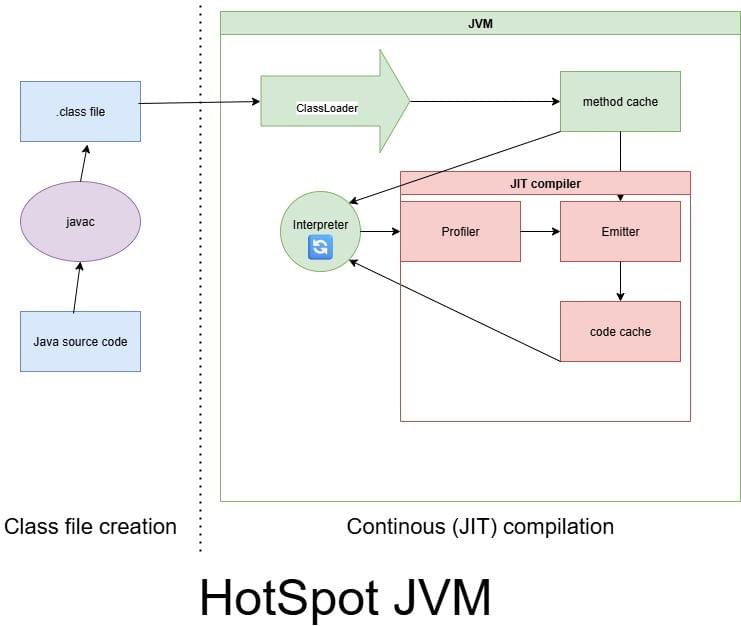
🔸 WHAT IS HOTSPOT JVM?
HotSpot is the JVM runtime (introduced in 1999) that made Java performance “serious”: not by pretending Java is C++, but by optimizing your actual running code at runtime.
It’s the engine behind the idea that Java can feel high-level… and still run very close to native speed. 🚀
🔸 THE “ZERO-OVERHEAD ABSTRACTION” FEELING (IN PRACTICE)
Java gives you abstraction: interfaces, virtual calls, lambdas, streams…
HotSpot tries to make those abstractions “disappear” when possible:
▪️ Inline small methods (even through interfaces)
▪️ Remove bounds checks when proven safe
▪️ Escape analysis to keep objects on the stack (or eliminate them)
▪️ Lock elision when contention isn’t real
Result: you write clean code… the runtime fights the overhead for you. 🧠✨
🔸 JIT COMPILATION: THE SECRET SAUCE
HotSpot starts by interpreting bytecode, then uses a JIT (Just-In-Time) compiler to turn hot code paths into optimized machine code.
Not “compile once, hope for the best”… but optimize based on reality: what’s executed most, what branches are taken, what types you actually see at runtime.
🔸 WHY JIT IS A BIG DEAL
Advantages that are easy to underestimate:
▪️ You don’t have to write low-level tricks everywhere (manual inlining, branch hacks, etc.)
▪️ The JVM can optimize differently per environment (CPU, workload, traffic pattern)
▪️ It can adapt over time as your app warms up and behavior changes
In short: less low-level complexity for developers, more consistent performance tuning by the runtime. ✅
🔸 PGO: PROFILE-GUIDED OPTIMIZATION (THE JVM DOES IT LIVE)
In native builds, PGO often means: run → collect profiles → rebuild with profiles.
HotSpot does a runtime-flavored version:
▪️ It collects profiles while your app runs (hot methods, types, branch probabilities)
▪️ Then re-optimizes the most valuable code paths
That’s why “warmup” exists—and why steady-state performance can be impressive. 🔥
🔸 ONE MORE RELEVANT THING PEOPLE FORGET
HotSpot can de-optimize.
If it made an assumption (ex: “this call always sees type X”), and later reality changes, it can rollback and recompile.
That flexibility is a huge part of why it can be aggressive and safe. 🛟
🔸 TAKEAWAYS
▪️ HotSpot (1999) is a major reason Java can be both productive and fast
▪️ JIT = performance based on real runtime behavior, not guesses
▪️ PGO-like profiling happens continuously during execution
▪️ Abstractions aren’t “free”… but HotSpot often makes them feel close to free
▪️ Warmup matters: measure performance correctly (cold vs steady-state)
#Java #JVM #HotSpot #Performance #JIT
🍃📗 Grab your Spring cert Book: https://bit.ly/springtify