🔸 THE QUESTION
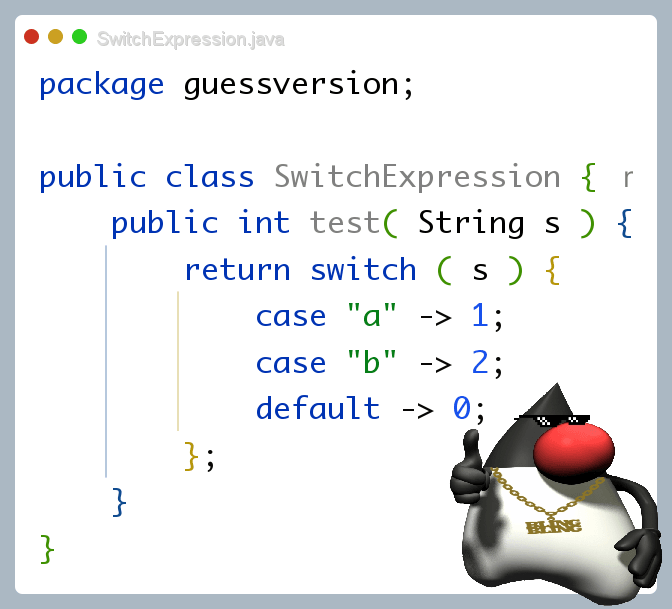
Can you identify the first Java version that supports this code as a standard feature? 👇
class Example {
 public int test(String s) {
 return switch (s) {
 case "a" -> 1;
 case "b" -> 2;
 default -> 0;
 };
 }
}
Which Java version is it?
▪️ Java 1.4
▪️ Java 7
▪️ Java 14
▪️ Java 16
▪️ Java 21
▪️ Java 25
🔸 TRY BEFORE CHECKING THE ANSWER 🤔
Take a moment before reading further.
This code is using a modern switch style:
▪️ the switch returns a value
▪️ the cases use -〉
▪️ there is no fall-through like in the old switch form
Do you have your answer? 👀
🔸 TLDR
If a switch returns a value directly and uses case -〉, think Java 14 ☕
🔸 THE ANSWER
✅ The correct answer is: Java 14
This code uses a switch expression.
That means the switch does not only execute code: it also produces a value that can be returned directly. The case -〉syntax is part of that feature, and switch expressions became a standard Java feature in Java 14 with JEP 361.
A related detail: yield is only needed when a case uses a block and must explicitly return a value from that block. In your example, each case already returns a simple value, so yield is not necessary.
🔸 WHY THIS MATTERS
This is a good example of how Java became more expressive over time.
With switch expressions, code is:
▪️ shorter
▪️ clearer
▪️ safer against accidental fall-through
▪️ closer to an expression-oriented style
That is why this feature is easy to recognize once you know what to look for.
🔸 TAKEAWAYS
▪️ switch expressions became standard in Java 14
▪️ case -〉 is a strong visual clue
▪️ yield is used only for block-style cases
▪️ This feature helps write cleaner and safer Java code
#Java #OpenJDK #Java14 #Programming #SoftwareDevelopment #CleanCode #Coding #Developers #Backend #TechQuiz
Go further with Java certification:
Java👇
Spring👇
SpringBook👇
JavaBook👇